Tissot Identifier: How to Identify a Tissot Watch
Quick answer
Identify a Tissot from the collection name on the dial — PRX, Seastar, Le Locle, Gentleman, T-Touch — and confirm with the T-format reference engraved on the caseback (like T137.407.11.041.00), which encodes the exact model, case, and dial. 'Powermatic 80' dial text marks the modern 80-hour automatic generation.
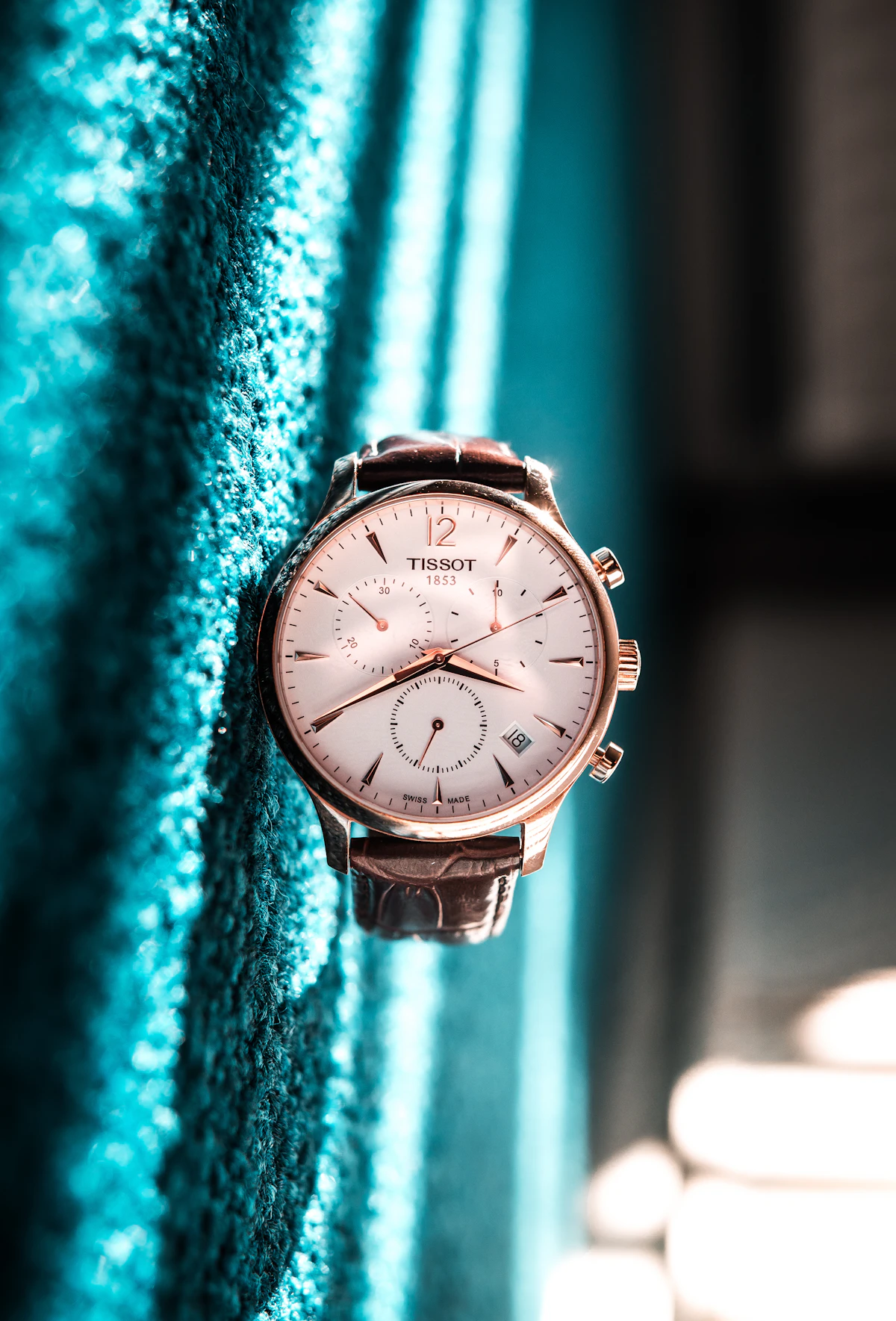
Tissot sits at the volume heart of Swiss watchmaking — the brand many people's first 'real Swiss watch' comes from — and identifies cooperatively: collection names on the dial, the 1853 founding date under the logo, and a fully systematic T-number reference on the caseback. A Tissot identifier is mostly a line map plus one reference format.
This guide covers the modern lines (the PRX phenomenon included), the T-number system, the Powermatic 80 generation marker, and the vintage Tissot corners that reward attention.
Which Tissot lines should you recognize on sight?
| Line | Recognition | Character |
|---|---|---|
| PRX | Tonneau case, integrated bracelet, waffle dial on autos | The 1978-revival hit; quartz and Powermatic 80 |
| Seastar | Dive bezel, 300m/1000 variants | The dive line |
| Le Locle | Classic dress, Roman numerals, guilloché | Named for the hometown; dress mainstay |
| Gentleman | Versatile round everyday | Quartz and Powermatic tiers |
| T-Touch | Tactile sapphire, altimeter/compass functions | The touchscreen tool pioneer |
| Chrono XL / V8 | Large sports chronographs | The volume chrono lines |
| Heritage | Reissues of archive designs | 1938 chronos, Navigator revivals |
The PRX carries most current identification questions: tonneau case, integrated bracelet, and — on the automatic — a waffle-textured dial. Quartz versus Powermatic 80 versions of the same look split meaningfully in price and behavior, and the dial text plus a sweep-versus-tick check separates them across a counter.
How does the Tissot T-number reference work?
Every modern Tissot carries a reference like T137.407.11.041.00 on the caseback: the leading group identifies the model family and case, subsequent groups encode movement type, case material/bracelet, dial color, and variant details. It's the most systematic reference format in its price class — search the full string and the exact watch returns, dial color included.
The caseback also carries water resistance and the sapphire declaration; the serial is engraved separately (and printed on the warranty card, for the standard papers match). One practical note: Tissot reuses family numbers across generations — T137 is the current PRX, T101 the previous PR100 family — so the full string matters, not just the prefix.
What does 'Powermatic 80' on the dial tell you?
Generation and tier. The Powermatic 80 is Swatch Group's modernized automatic (an ETA 2824 descendant re-engineered to an 80-hour reserve, running in Tissot with a Nivachron antimagnetic balance spring in recent production) — and Tissot prints the name on the dial of every watch that carries it. That text instantly identifies the modern automatic generation versus older ETA-marked models and the quartz lines.
For buying: the 80-hour reserve is a genuine weekend-proof convenience, the movement services affordably, and the marker separates near-identical PRX and Gentleman variants across a real price step. Older Tissots marked 'Automatic' with ETA 2824/2836 or the 7750 chronograph base identify their eras the same way — movement text as dating evidence, printed where you can read it.
How do you identify a T-Touch and what makes it distinct?
The T-Touch identifies by behavior: tap the sapphire crystal and the hands become a compass needle, altimeter display, or thermometer pointer — Tissot pioneered the tactile-crystal multifunction concept in 1999. Solar generations (T-Touch Connect and Expert Solar) mark themselves on the dial; earlier generations run batteries.
Identification note: T-Touch functions failing is the common secondhand issue (touch calibration, battery, sensor faults), so function-testing everything is the purchase check here — a T-Touch whose crystal doesn't respond is a repair quote, not a discount opportunity.
Which vintage Tissots reward identification effort?
More than the brand's affordable image suggests. Vintage corners with real collector markets: mid-century Tissot chronographs (often sharing Lemania movements with Omega — the companies were allied for decades), the Navigator world-timers, early Seastar divers and PR516 sports models, and the 1970s Sideral fiberglass-cased pieces. Identification runs on vintage rules: caliber stamps, caseback references, era design cues.
The Omega alliance detail matters for drawer finds: a vintage Tissot chronograph with a Lemania-based caliber is mechanically a sibling of far pricier Omegas, and the market has been noticing — originality verification before selling one is the difference between a beater price and a collector price.
What's the complete Tissot identification workflow?
- Read the dial: collection name, 1853 signature, and movement text (Powermatic 80, Automatic, or quartz silence).
- Flip it: the full T-number identifies the exact variant when searched; note the serial for records.
- Scan the watch if the caseback is inaccessible — the catalog identifies well from dial-side photos.
- Behavior-check the tier: sweep vs tick, and full function tests on T-Touch models.
- For vintage pieces, movement caliber and caseback stamps take over — with Lemania-based chronographs flagged for specialist attention.
Tissot is high-volume, well-documented, and honestly labeled — the identification challenges are mostly generational (which PRX? which Seastar era?) and the T-number answers them exactly.
What should buyers know about the Tissot market?
Tissot's secondhand market is one of the friendliest places to buy Swiss mechanical watches, and identification precision is what unlocks it. Because production volumes are high, ordinary references trade at gentle discounts to retail with plenty of choice — a verified T-number plus honest condition photos is a low-risk purchase in a way few luxury-tier listings can match.
The specific things worth checking: Powermatic 80 versus older ETA generations (same looks, different reserves and service economics — the dial text settles it), quartz versus automatic PRX variants (a real price step between visually similar watches), and on T-Touch models, full function tests before any money moves, since sensor repairs can exceed the watch's value.
Counterfeit pressure at Tissot's price point is modest but not zero — fakes of the PRX have appeared with its popularity. The standard screen applies scaled down: printing quality under macro, caseback reference coherence, and the sweep-or-tick behavior matching what the dial claims. At these prices a watchmaker inspection rarely pays; the free checks carry the weight.
Key takeaways
- Collections name themselves on the dial: PRX, Seastar, Le Locle, Gentleman, T-Touch.
- The caseback T-number (T137.407.11.041.00 format) encodes the exact model, case, movement, and dial.
- 'Powermatic 80' dial text marks the modern 80-hour automatic generation and its price tier.
- T-Touch identifies by tactile-crystal behavior — and demands full function testing secondhand.
- Vintage Tissot chronographs often carry Lemania movements shared with Omega — collector territory.
- Family numbers recur across generations; search the full T-string, not just the prefix.
Identify your watch in seconds
Snap a photo and Watch Identifier suggests the likely brand, model, value range, and authenticity signals — then saves it to your collection.


Frequently asked questions
How do I identify my Tissot model?
Read the collection name on the dial, then search the full T-format reference from the caseback (like T137.407.11.041.00) — it returns the exact model, case size, movement, and dial variant. The reference is more precise than the collection name alone.
What does Powermatic 80 mean on my Tissot?
It's Tissot's modern automatic movement with an 80-hour power reserve (versus ~38 hours on older ETA generations), marked on the dial of every watch carrying it. It identifies the current automatic generation and runs weekend-proof on a full wind.
Is the Tissot PRX quartz or automatic?
Both exist: quartz PRX models (thinner, no dial waffle) and Powermatic 80 automatics (waffle dial, 'Powermatic 80' text, sweeping seconds). The dial text and seconds-hand behavior separate them instantly, and the T-number confirms — they sit a real price step apart.
Where is the serial number on a Tissot?
Engraved on the caseback, separate from the T-format reference, and printed on the warranty card for matching. The reference identifies the model; the serial your individual watch.
Are old Tissot watches valuable?
Selectively, yes: mid-century chronographs with Lemania calibers, Navigator world-timers, early Seastar divers, and PR516 sports models have genuine collector markets. Identification via movement caliber and caseback stamps — before pricing — is what separates beater money from collector money.
Written by the Watch Identifier Team
We build the Watch Identifier app and spend our days testing AI identification against real watches — from flea-market finds to five-figure chronographs. Guides are checked against brand documentation and refreshed as models and markets change.


